
The Valkyries went 0-3 against the Aces in the regular season. But the playoffs are a fresh start, and the defending champs are the only thing standing between Golden State and its first WNBA Finals. They got that fresh start off right, taking Game 1 at Ballhalla on Sunday, 71-60, and they did it the way they've won all year: with defense. Las Vegas made just 21 of its 62 shots and finished with its lowest score of the season.
A year ago, the Valkyries made the playoffs in their very first season and went out in the first round to the Lynx. This year they won the first playoff series in franchise history, a three-game battle with the Dallas Wings that ended 77-73 at home. And all of this in a season that, for months, wasn't even guaranteed to happen while the league and the players' union worked out a new CBA.
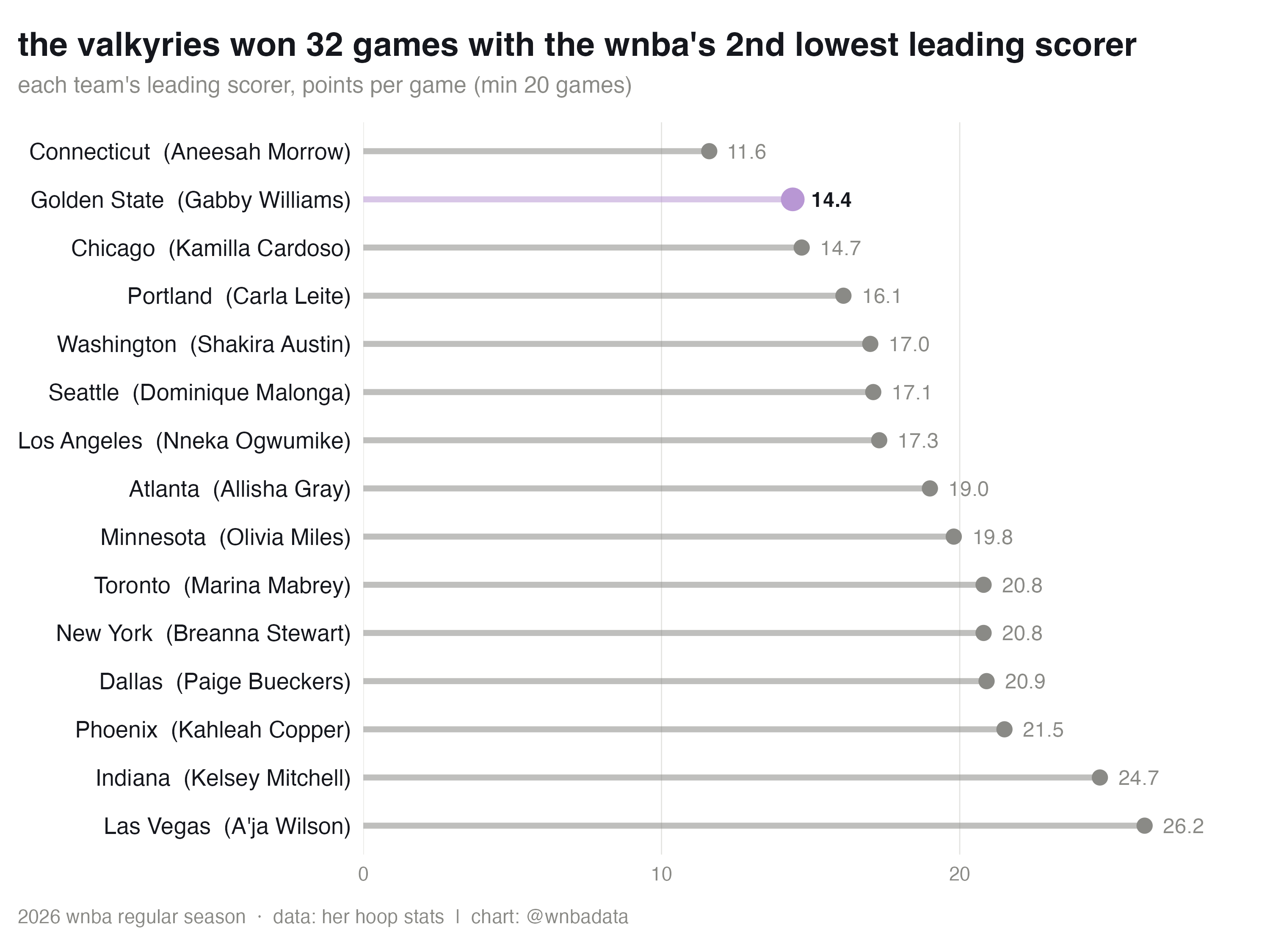
They're doing all of this without a superstar, too. In their second regular season ever, the Valkyries finished 2nd at 32-12, and their leading scorer averaged 14.4 points per game. The typical WNBA team's leading scorer averaged 19 points this year.
That 14.4 belongs to Gabby Williams (yes, I am still her #1 fan). Second to Gabby in scoring were Janelle Salaün (12.7 ppg), who literally started zero games this season (and was just named the unanimous Sixth Player of the Year), and Veronica Burton (12.2 ppg), a player who was almost out of the league after being waived by the Dallas Wings (the team that drafted her) in 2024. No one on this team averaged more than 29 minutes a night, and there isn’t even a clear second option, either.
So how do you win 32 games without a superstar? The short answer: you have the best defense in the league, and the highest-scoring bench in WNBA history. The long answer has some numbers:
the starters
First, the starters. By almost every shooting number, they are the least productive starting five in the league:
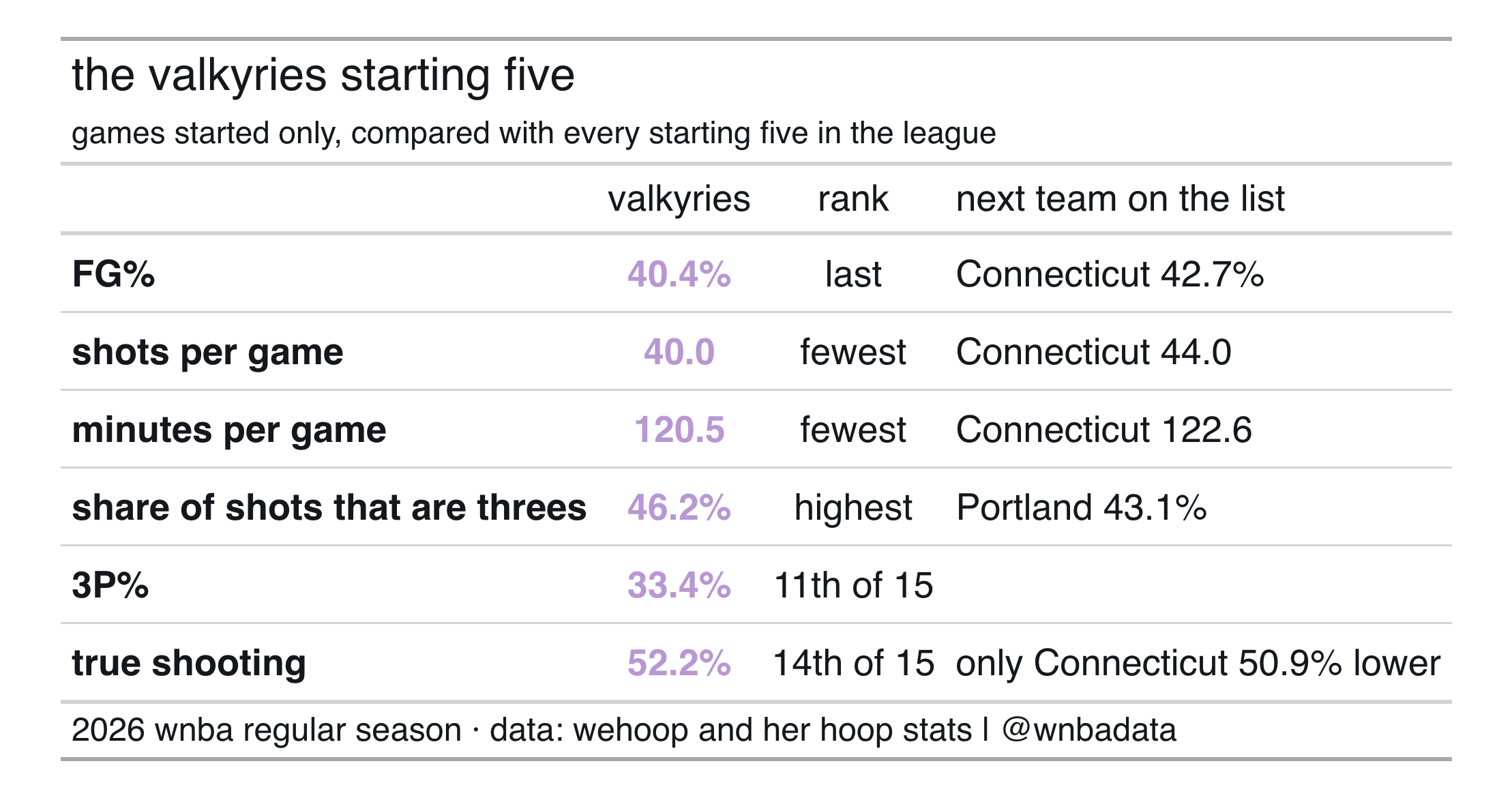
To be fair, the Valkyries play with a VERY slow pace (77.4 possessions a game, slowest in the league). They maintain a slow pace, probably partly because they play a stifling defense that causes their opponent to drain their own shot clock. This leads to fewer scoring opportunities for the Valkyries (starters and bench) per game.
But however fast or slow you play, a 40% shooter is still a 40% shooter. So if the starters aren’t scoring, then who is?
the power of benchship
The Valkyries bench scored 35.9 points per game this season, the most by any bench in WNBA history. The old record was 35.0, set by the 2020 Las Vegas Aces (who got swept in the finals by the Seattle Storm).
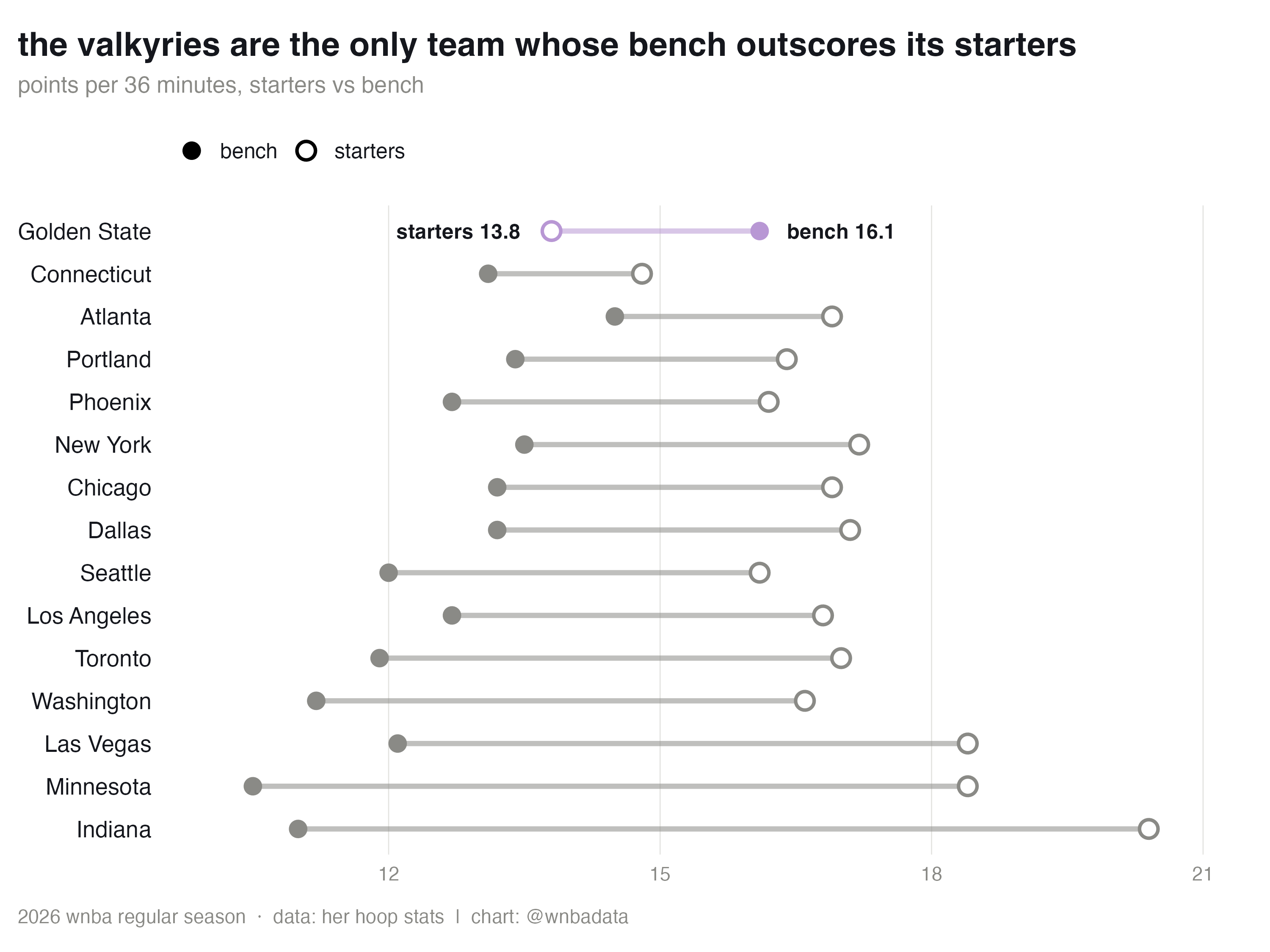
And it’s not just that the Golden State bench plays a lot (which they do, about 80 minutes a game, which is the most in the league). Per minute, the Valks bench actually scores more than the starters, 16.1 points per 36 compared to 13.8. The bench also outshoots the starters with 56.4% true shooting vs 52.2%. The same cannot be said about any other team. On the other 14 teams, the starters score at a higher rate.
At the top of the bench is Janelle Salaün, who scored 509 points this season without starting a single game, good for the most points off the bench in any WNBA season. She also set bench records for threes (93) and 10-point games (27), and she was just named Sixth Player of the Year, getting all 74 votes. Right behind her in points off the bench are Tiffany Hayes (337) and Kaitlyn Chen (315), which means that three of the league’s top four bench scorers are Valks (the other is Sophie Cunningham of the Indiana Fever, who scored 316 off the bench, one more than Chen).
The Valkyries bench is also very clearly having the most fun of anyone in the building, which is hard to do in Ballhalla. The SF Standard has the full rundown: Kayla Thornton's pregame dance circle, a "Go Valks" chant passed down from Temi Fagbenle, and Kaitlyn Chen riding onto the court on Veronica Burton's back. Natalie Nakase has apparently asked them to tone it down. Tiffany Hayes, in her 13th season, called it the best bench she’s ever been part of.
That’s the Power of Benchship <3
the defense
There are two sides to every basketball game, and none of the scoring the Valkyries do (or don’t do) would matter without defense.
The Valkyries starters shoot 40.4% from the field, the worst of any starting five in the league. And Golden State holds its opponents to 41.4%, the lowest in the league by a wide margin (the next lowest was 43.1%, against the Washington Mystics). The Valkyries basically make every team they play look like their own starters (roasted). Teams also turned the ball over on 17.7% of their possessions against Golden State, and only the Atlanta Dream forced turnovers more often (18.6%). So teams playing the Valkyries miss more shots than they do against anyone else, and they lose the ball before they even get to shoot more often than almost anywhere else.
Their raw points allowed (75.1 per game) looks even more dramatic, but some of that is because Golden State plays slower than any other team in the league. A fairer measure might be points allowed per 100 possessions, and by that metric, the Valkyries allow 97. The league average this season was 105.8 points allowed per 100, and second place was Atlanta (home of DPOY Angel Reese) at 101.2, which means the gap between Golden State and 2nd place is bigger than the gap between 2nd place and 5th.
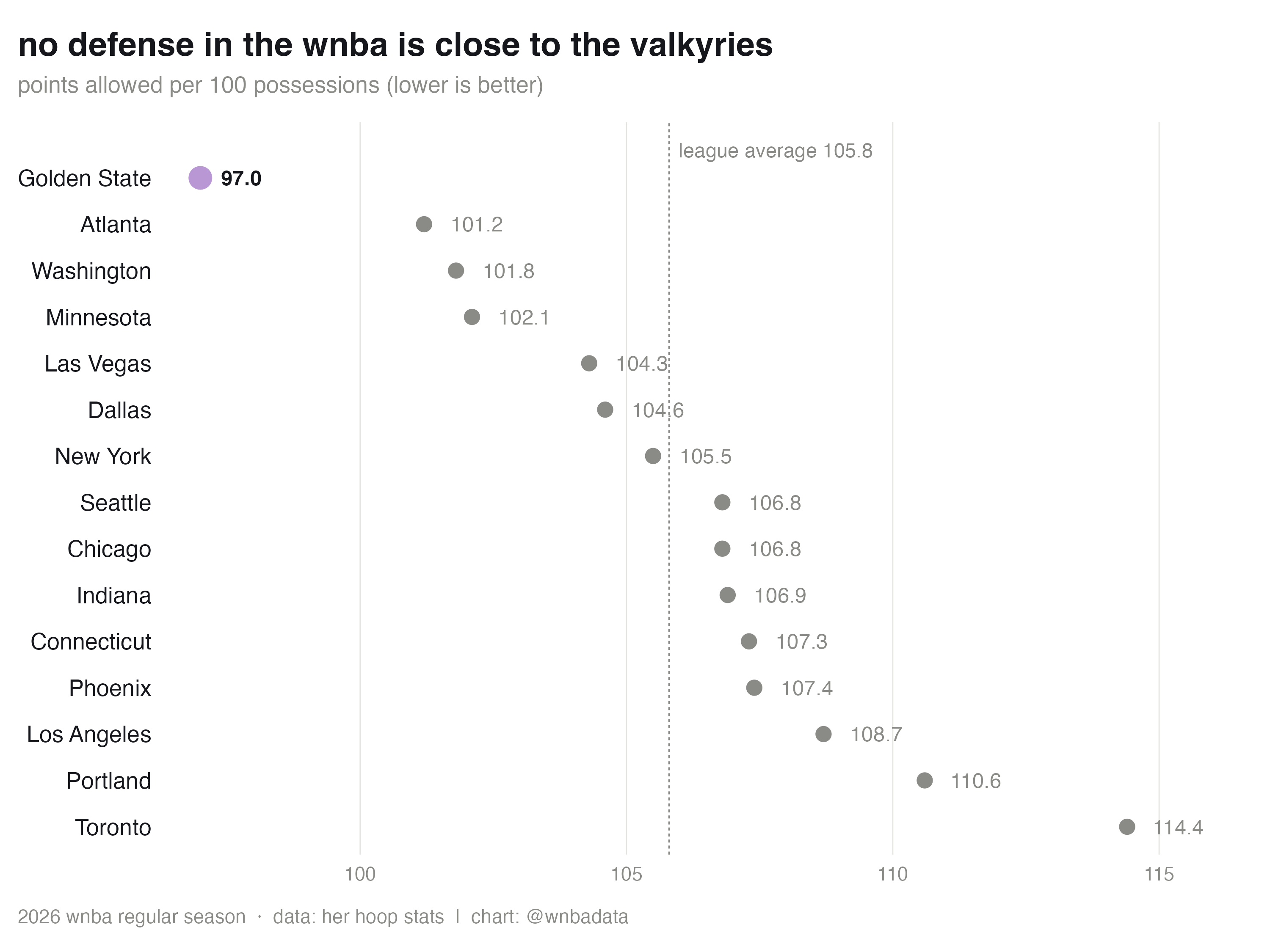
If you compare every team in WNBA history with its own season’s league average, this defense would be in the top handful ever, next to teams like the 2002 Houston Comets and the 2021 Connecticut Sun. (the exact ranking depends on how you count possessions)
So the Valkyries starters don’t score much, and it doesn’t matter, because nobody scores much against them either.
so, how do you win 32 games without a superstar?
Just have a starting five that doesn't need to score, a bench that scores more than the starters do, and a defense nobody else in the league can touch. None of this requires the luck of a player getting the hot hand, which is what makes them so hard to beat.
It’s also kind of absurd that this is only year 2 of Joe Lacob’s 5-year championship plan. No WNBA expansion team has ever had a second season like this one. The next best was the 2001 Miami Sol, who went 20-12 and outscored teams by less than 2 points a game. The Valkyries went 32-12 and outscored opponents by an average of 7.
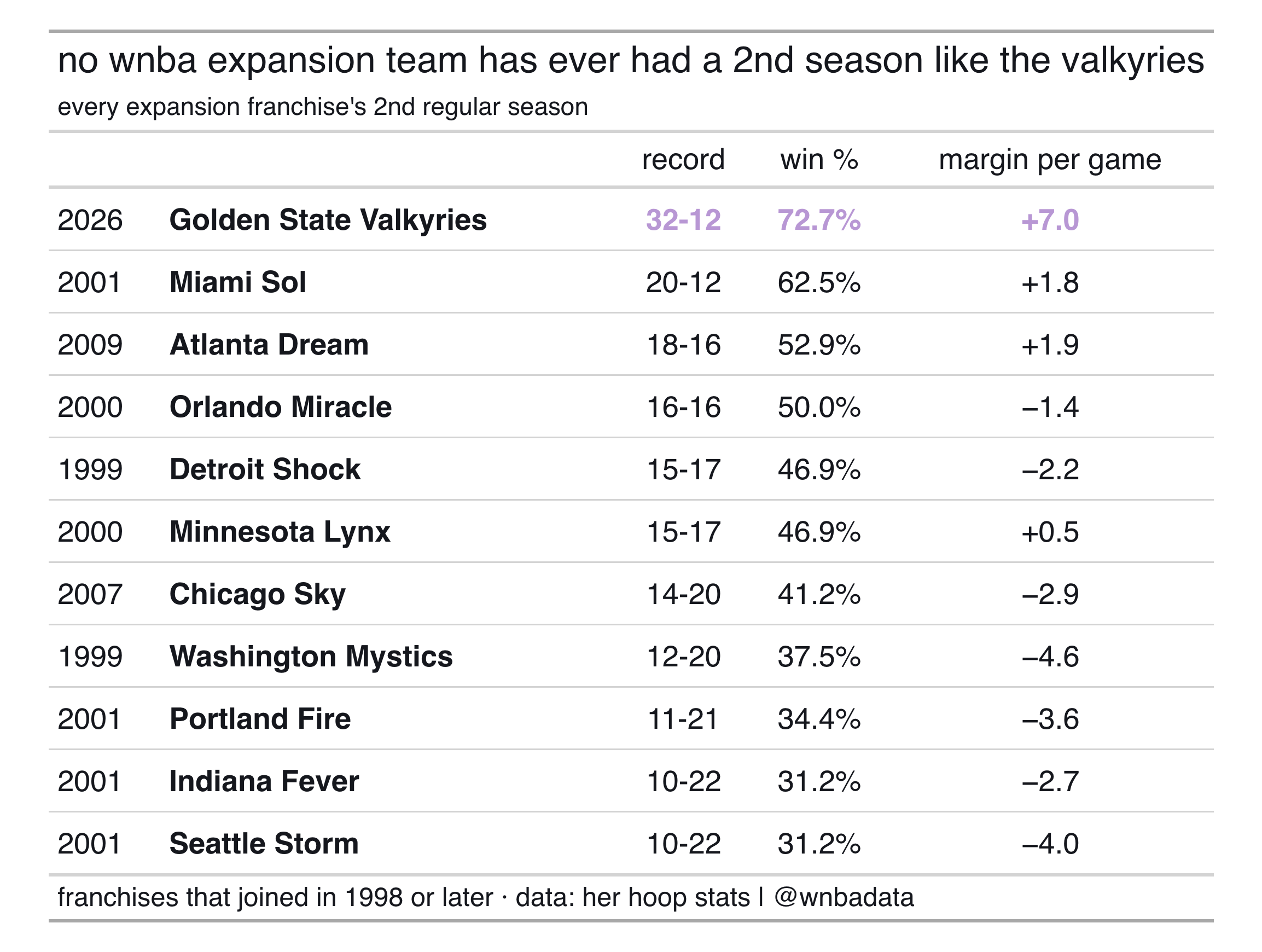
Whatever happens in the semifinals, the Valkyries have already shown that you don’t need a superstar to be one of the best teams in the league. You need a lot of people who are really good at their jobs.
Stats via Her Hoop Stats and wehoop, 2026 WNBA regular season.